Request a plan
- Open a conversation in the project you want to investigate.
- Open the permission menu and select Plan.
- Describe the outcome, constraints, and questions the plan should answer.
- Send the request and review the response. Answer any questions from the agent before continuing.
Read only README.md and index.html. In no more than 180 words, propose a plan to keep completed trails after a browser refresh and add a Reset button that clears only trail progress. Name the files to change and the checks you would use. Do not edit or create files, run tests, access the network, or delegate. Return the plan and finish this turn.The mode governs permitted actions; your prompt supplies the task. Asking for a plan in ordinary prose does not itself select Plan mode. Conversely, choosing the mode does not send a task until you submit a prompt. Plan mode restricts implementation actions. Some harnesses maintain a plan file, so planning can include writing that artifact. The step checklist shown during a response is a separate progress display. A checklist does not itself select Plan mode or create a plan-review request.
Plan remains selected after this Codex conversation returns its proposal. The full workspace shows the proposed changes and checks, with no implementation performed.
View the planning response in Zen
View the planning response in Zen
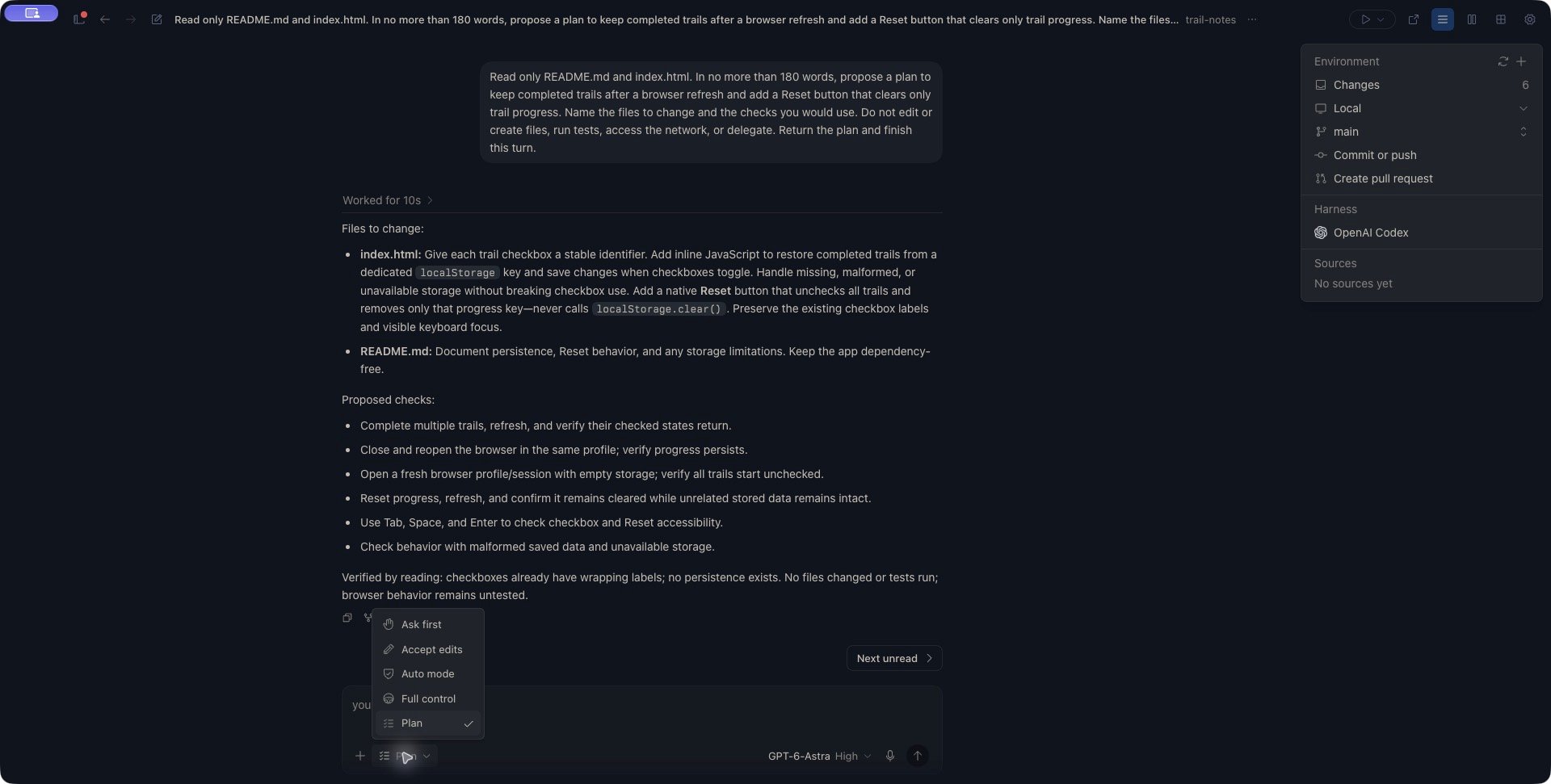
Check the proposed approach
Before approving work, check that the plan covers:- The behavior you want and what should stay unchanged.
- The files or parts of the project involved.
- Failure cases, recovery, and any assumptions that need your decision.
- How the agent will verify the result, including the first real user interaction.
Refine a plan written in chat
If the agent returns a normal response, keep Plan selected and send a follow-up describing the revision you want. For example:Refine the plan without implementing it: add the user-visible behavior when saving progress fails or Reset cannot remove saved progress. Keep the checklist usable. Use only our existing discussion, do not use tools or delegate, and finish in no more than 100 words.Read the revised response and check that it includes the new constraint. A completed planning response does not automatically change the permission mode or start implementation. When you are ready to implement a plan that has no review card, select an appropriate permission mode, such as Ask first or Accept edits, and send a new request stating which plan to implement and which checks to run. Selecting a mode in an idle conversation stages it for that next send.
Review a submitted plan
When the harness submits a plan through Kisuke’s plan-review workflow, the composer shows Plan ready with the proposal and its actions. An ordinary response containing a list of steps does not necessarily create this review card. Read the proposal for the intended behavior, affected files, testing, and any assumptions you need to resolve.A submitted plan from Claude Code using DeepSeek V4 Flash. The review stays pending until you choose Implement or Dismiss plan.
View the submitted plan in Zen
View the submitted plan in Zen
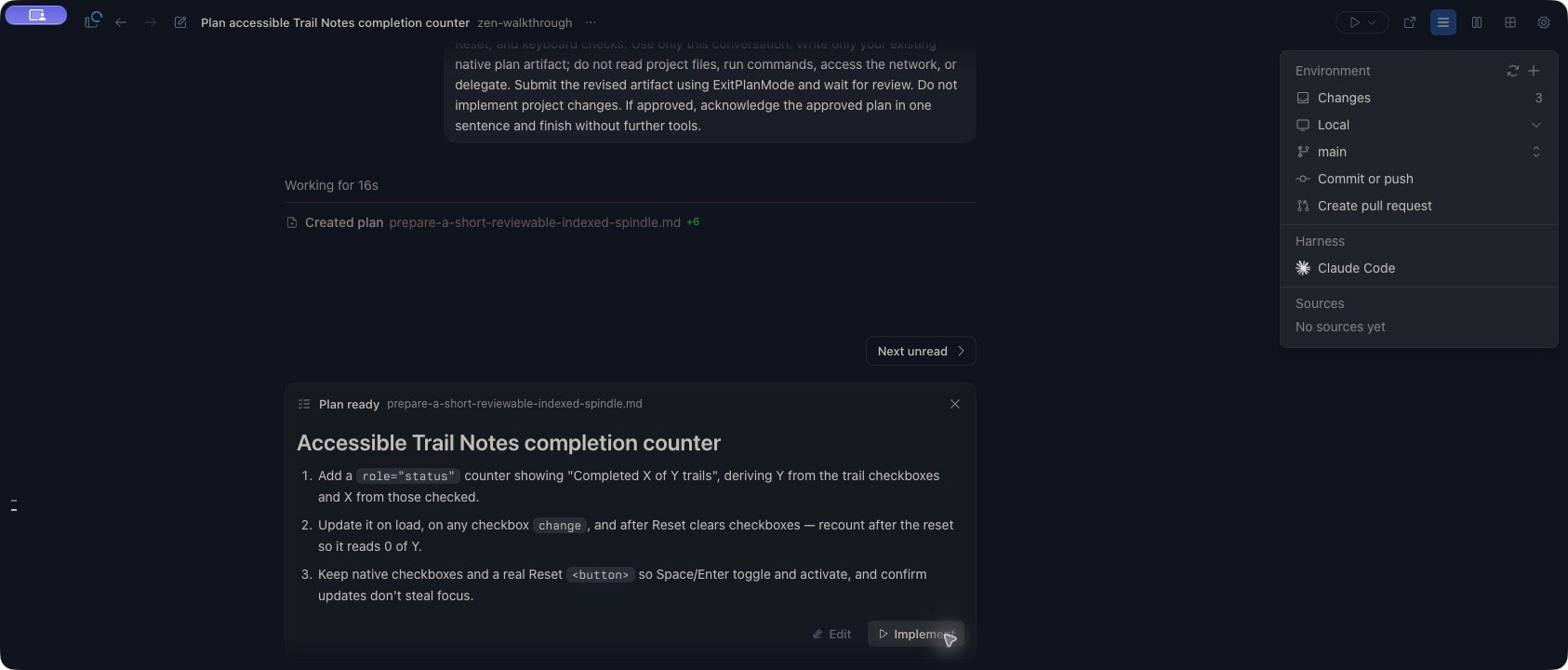
Implement authorizes the next work; it is not a confirmation that the implementation has already finished. Other actions can still require approval under Accept edits.
To request a different approach from a pending review card, use Dismiss plan, wait for the current turn to stop, and send a new planning request with your corrections. Dismissal does not undo files the agent already created while preparing the plan.
Edit before approving
On desktop and web, if the plan has an associated file:- Select Edit to open it in the file editor.
- Wait for the plan text to load, then make your changes.
- Save and confirm that saving succeeds before selecting Implement.
If the plan file will not open
If the editor shows Could not open withresource_context_mismatch, the file has not loaded. This can occur for a harness-generated plan even while its review card is visible. Do not enter replacement text into the empty editor or assume that Editing means your changes will be approved.
Close the failed file tab to return to the proposal in the review card. If you need changes, choose Dismiss plan, wait for Response interrupted, and send your corrections with Plan still selected. Ask the agent to revise and resubmit the plan, then review that new proposal before approving it.
For example:
Revise the dismissed plan to a title and three short steps. Include updates after Reset and keyboard checks. Update the plan artifact and submit it for review. Do not implement project changes yet.
Plan and review on mobile
On iOS and Android, open Chat settings from the model control. In Permission, select Plan when supported, then return to the composer and send your planning request. The supported mode controls depend on the harness. A submitted plan appears as Plan ready in the composer. Scroll through the proposal before choosing Implement. The × control is labelled Dismiss plan and rejects the review; it is separate from cancelling edits. Mobile edits use an inline text field:- Check that the plan header shows an associated filename, then choose Edit.
- Make your changes under Editing plan.
- Choose Save, then wait until the preview shows your edited text before approving. Cancel leaves editing without saving those changes.
If no filename appears in the mobile plan header, request a revised plan instead of relying on inline edits. Those edits currently update the displayed draft, but approval still uses the plan originally submitted for review.
Exit without a submitted plan
A harness can request to leave planning without supplying a plan for review. In this case, the composer shows Exit plan mode? and No plan was created.- Choose Keep planning to decline that exit and remain in the planning workflow.
- Choose Exit plan mode to allow the exit. A conversation leaving Plan this way switches to Ask first.