> ## Documentation Index
> Fetch the complete documentation index at: https://docs.kisuke.dev/llms.txt
> Use this file to discover all available pages before exploring further.
# Open a project
> Choose a device and folder, then open your project in the Zen workspace.
A project starts with a folder on a device. Choose both so Kisuke can open the right files and terminal environment. The same folder name on two devices does not mean the same files.
These steps describe the desktop and web folder browser. You need an available device containing the folder you want to use. For another computer or a phone client, start with [Connect devices and pair your phone](/workspace/devices).
## Open an existing folder
1. On the project landing screen, choose **Open project**. From an existing workspace, use **Open folder** in the sidebar.
2. In **Browse Folders**, select the device containing your project.
3. Navigate to the project folder. You can also enter its path in the path field and press Enter. The path is on the selected device.
4. Select the folder, or navigate inside it, then choose **Open**.
5. Check the project and device shown above the composer before starting work.
The folder browser offers parent-directory, back, and forward controls. **Home** opens the selected device's home directory when available. On Windows, the browser can show available drives.
An offline device cannot be selected for browsing. If **Connecting…** or **Loading location…** remains visible, the folder listing is not ready yet.
## Create a folder while browsing
Navigate to the parent directory on the intended device, then choose **New Folder**. Enter a name and choose **Create**. Once it appears as the selected folder, choose **Open** to use it as a project.
Creating a folder and opening it are separate steps. If creation fails, correct the reported name, path, or access problem before trying again.
## Inspect the workspace before your first prompt
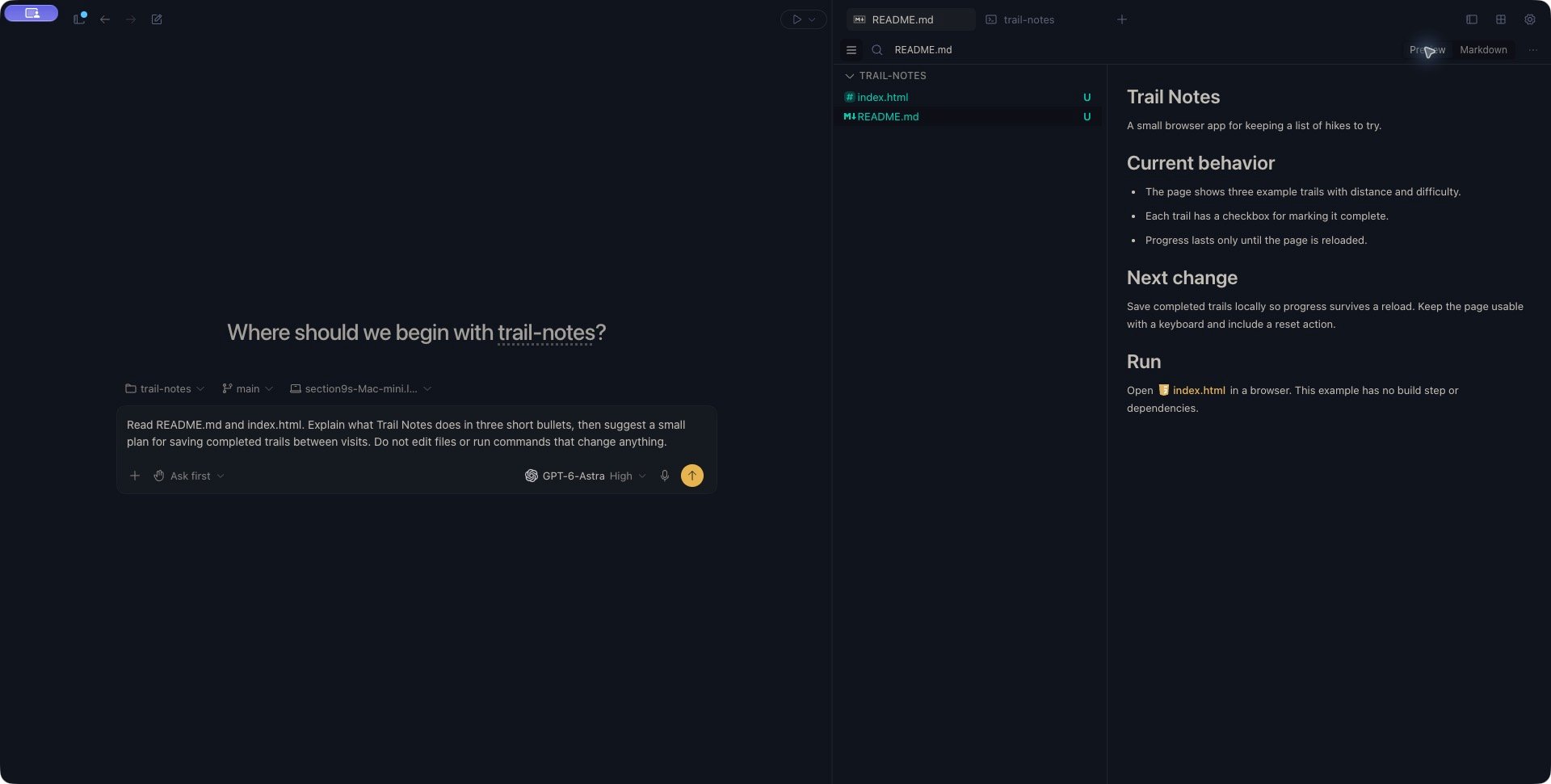
In [Zen mode](/zen-mode), you can inspect the project before sending a message:
1. Open the right panel and choose **Files**.
2. Open a README or another familiar file to confirm the folder contents.
3. Open a **Terminal** from the panel's new-tab menu if you want to inspect the working directory yourself.
4. Choose your [harness and model](/models/overview) and [permissions](/conversations/permissions), then write your request.
 Opening a folder does not prove a model is ready to run. Provider access and model selection are separate prerequisites. If the first message is rejected, use the specific [start-error guidance](/help/starting-a-chat).
## If the folder will not open
| What you see | What to check |
| - | - |
| **Offline** beside a device | Make that device available before browsing its folders. |
| **Location unavailable** | Check that you are selecting the intended available device. |
| **Failed to list folder** | Read the error details and verify the path exists and is readable on that device. |
| **Couldn't open folder** | Keep the dialog open and use the accompanying error to correct the path or connection problem. |
After an error, confirm the project shown in the workspace before acting. Choosing a folder in the browser is not the same as successfully opening it.
Continue with [Files and the editor](/workspace/files) or [Terminal](/workspace/terminal). To work on another branch in a separate folder, [create a worktree from Zen](/projects/worktrees).
This documentation is built and hosted on [Mintlify](https://mintlify.com), a developer documentation platform.
Opening a folder does not prove a model is ready to run. Provider access and model selection are separate prerequisites. If the first message is rejected, use the specific [start-error guidance](/help/starting-a-chat).
## If the folder will not open
| What you see | What to check |
| - | - |
| **Offline** beside a device | Make that device available before browsing its folders. |
| **Location unavailable** | Check that you are selecting the intended available device. |
| **Failed to list folder** | Read the error details and verify the path exists and is readable on that device. |
| **Couldn't open folder** | Keep the dialog open and use the accompanying error to correct the path or connection problem. |
After an error, confirm the project shown in the workspace before acting. Choosing a folder in the browser is not the same as successfully opening it.
Continue with [Files and the editor](/workspace/files) or [Terminal](/workspace/terminal). To work on another branch in a separate folder, [create a worktree from Zen](/projects/worktrees).
This documentation is built and hosted on [Mintlify](https://mintlify.com), a developer documentation platform.